Gym for your mind
Why do gyms exist?
For most of human history, nobody needed one. Movement was built into the day. We walked everywhere, carried water and grain, worked with our hands. Strength came free with living.
Then machines took over the work. Life got easier, and staying strong stopped being automatic. It became something you had to choose.
So now we pay to lift weights that a machine could lift for us. Nobody finds that strange, because nobody goes to the gym for the weight. It goes up, it comes down, and nothing in the world has changed except the person who lifted it.
AI is about to make the same distinction matter for the mind.
Two things from every task
Every task gives you two things: the result, and the ability you build while producing it.
For most of history the two came bundled. If you wanted the essay, you had to write it, and writing it made you a better writer. If you wanted the bug fixed, you had to find it, and finding it taught you how the system worked. You could not get the result without the ability, so nobody had to ask which one they were after.
AI unbundles them. It can hand you the result in seconds. The ability does not come with it.
Reading an explanation is not the same as learning to explain. Accepting a solution is not the same as learning to solve. Watching someone else lift is not a workout.
What practice does to a brain
To get a licence, a London taxi driver has to pass the Knowledge: roughly 25,000 streets within six miles of Charing Cross, held in memory, with the route between any two points worked out on demand. It typically takes three to four years.
In 2011, Katherine Woollett and Eleanor Maguire published a study that followed 79 trainees. They scanned their brains before training and again several years later. At the start, the trainees looked no different from anyone else. By the end, the ones who had qualified had more grey matter in the posterior hippocampus, a region involved in spatial memory. The trainees who did not qualify showed no such change. Neither did a control group who never trained.
I want to be precise about what this shows. It does not prove that AI weakens our brains. It shows something narrower and, I think, more useful: sustained, effortful learning physically changes the person doing it. Every phone now holds the map those drivers memorised. None of them holds what the memorising did to the drivers.
You can only judge what you can do
The question I hear most from students is some version of this: why should I struggle with it when one prompt can do it for me?
My answer is that you will spend the rest of your working life judging results you did not produce, and you can only judge what you understand.
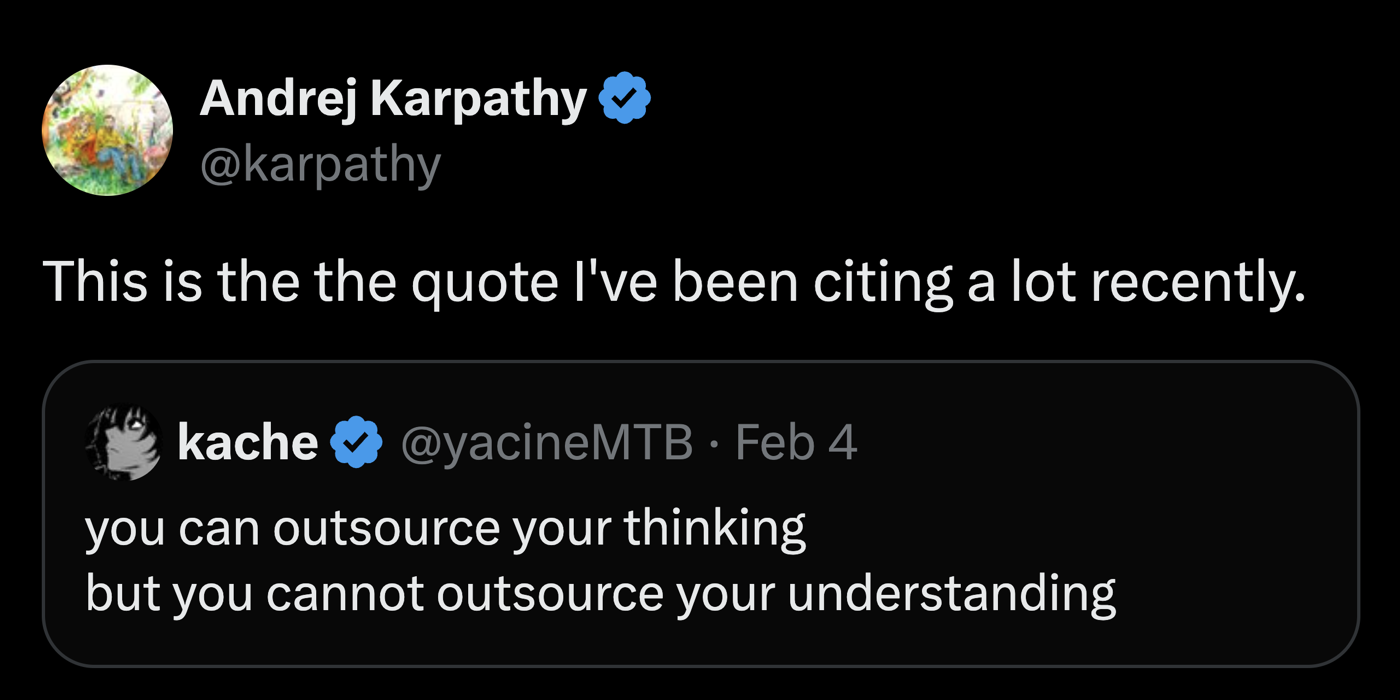
I have argued before that the bottleneck in AI work is no longer the output. It is the review. Reviewing well means knowing what good looks like, where this kind of answer usually goes wrong, and which part of it is guessing. None of that comes from reading answers. It comes from attempting the problem, finding the exact place your reasoning broke, and working through the mistake until you see why it broke. That is how you build the judgment you will need for the next answer the machine gives you.
Feynman kept a line on his blackboard: “What I cannot create, I do not understand.” The same goes for checking. What you cannot do, you cannot verify.
Attempt first, then bring in the machine
So in my classes, some assignments ask you to think first. Make an attempt. Write down your reasoning. Then bring in AI and use it to attack what you wrote: find the gaps, challenge the assumptions, show you a better route. The order is the whole point. AI after the attempt sharpens you. AI instead of the attempt replaces you.
It is the rule I use for building anything: manual first, automation later. You do not need to do everything by hand forever. You need enough reps to understand what you are delegating, and to recognise when it goes wrong.
Struggle is not the goal
None of this is a case for suffering. Pain is not the goal at the gym either. Grinding out reps with bad form until you get hurt is not discipline.
Struggle is useful when it leads to understanding. If you have been stuck for an hour and learned nothing in the last forty minutes, you are no longer training. Ask for help.
A training partner
The best way I know to think about AI is as a training partner. A good one watches your form and tells you what you got wrong. It makes the work lighter when you are failing and heavier when you are coasting. It gets you to attempt things you would not attempt alone. A good spotter keeps the bar off your chest. A good spotter does not lift it for you.
AI can be all of that, if you use it that way. You still have to do the reps.
The machine can finish your task. It cannot do your learning for you.